

3 key misconceptions about RUPA’s third tier proposal

Matt Rowley February 7, 2013 18

No GravatarIt’s the hottest day in the history of Sydney and Greg Harris, the CEO of RUPA, is talking me through his organisation’s proposals for the evolution of Australian rugby outside a cafe in Surry Hills.

Harris - mid expletive

Harris – mid-expletive

It’s not just Greg’s F- and even C-bombs (refreshing after 20 years of business in the UK) that have got my attention in this crushing heat, but also the vision that he unfolds over an hour. He readily admits it’s not a panacea and that it will have its points of friction among stakeholders. But it’s a different take on an intractable challenge — for which, if there were an easy answer that wouldn’t piss someone off or send them broke, would have surely been solved by now.

In the week following that meeting, Wayne Smith wrote a piece in The Australian (paywalled, but republished here by FoxSports) about the proposal and since then there’s been a heap of chatter over it — not least six pages of it or more in our own G&GR forum.

Now, the original proposal is necessarily pretty chunky and therefore not easy to condense into a readable print article, so I thought it’d be worthwhile clearing up a few key misconceptions that I’d spotted around the place compared to what I’d heard from Greg as he perspired over his flat white.


The new third tier is a new uni-based rugby comp.
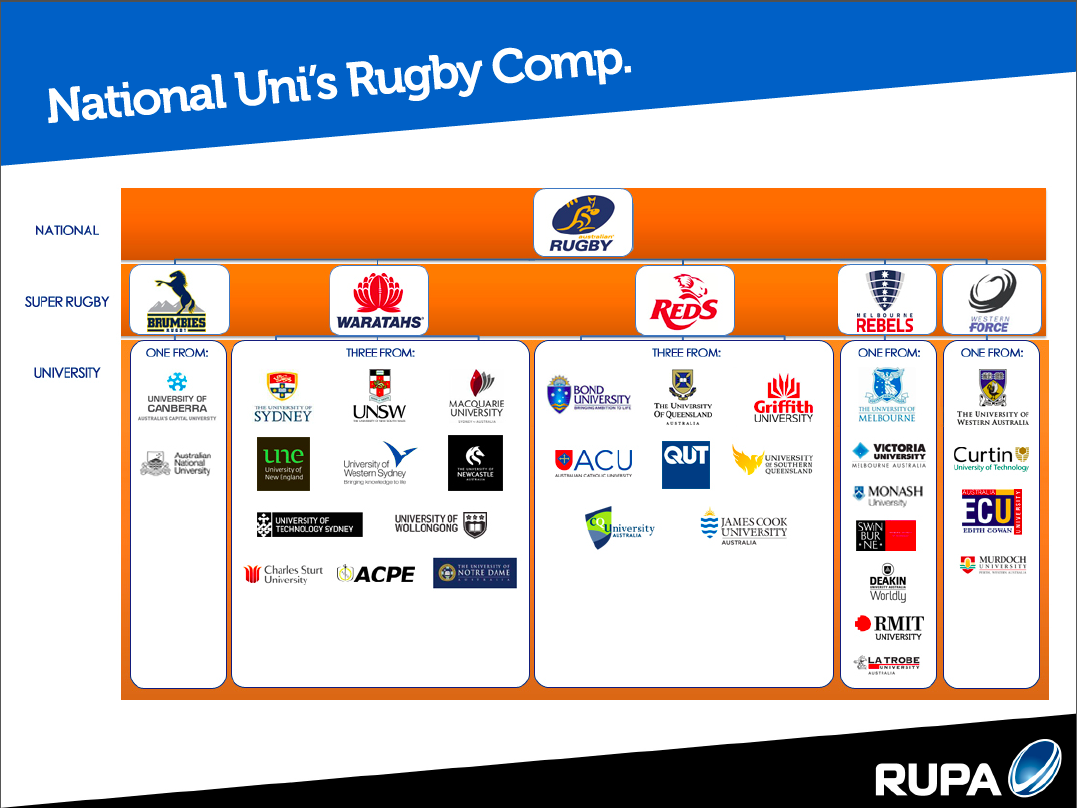
rupa uni schema

Click to embiggen

Not true. The proposal is that there be two new comps to help boost the talent growth and distribution in Australian rugby. There is no new ITM or Currie Cup analogue, the reality being we just don’t have the market for it (neither does New Zealand, by the way).

One of the new comps is a cup extension to the premier rugby competitions across Australia — The Australian Club Championship.

The other is a nation-wide Under 23 university-based competition (I’ll refer to it as the Uni Comp) that doubles as an academy feeder system into Super Rugby — see the inset diagram of its structure. The chief role of this comp will be to provide a transparent pathway into Super Rugby, thereby attracting and retaining more talent.

How so? Well, think of the 900 AFL prospects who don’t get drafted each year, or the 250 players who drop out of rugby league’s Toyota Cup without a contract. Which would be more attractive to one of these guys (or any young rugby player):

1. a uni degree while playing comp footy with top facilities as part of a Super Rugby academy,
or
2. no career path as an amateur rugby player in a team with no guaranteed Super exposure?


This proposal will be the death of club rugby
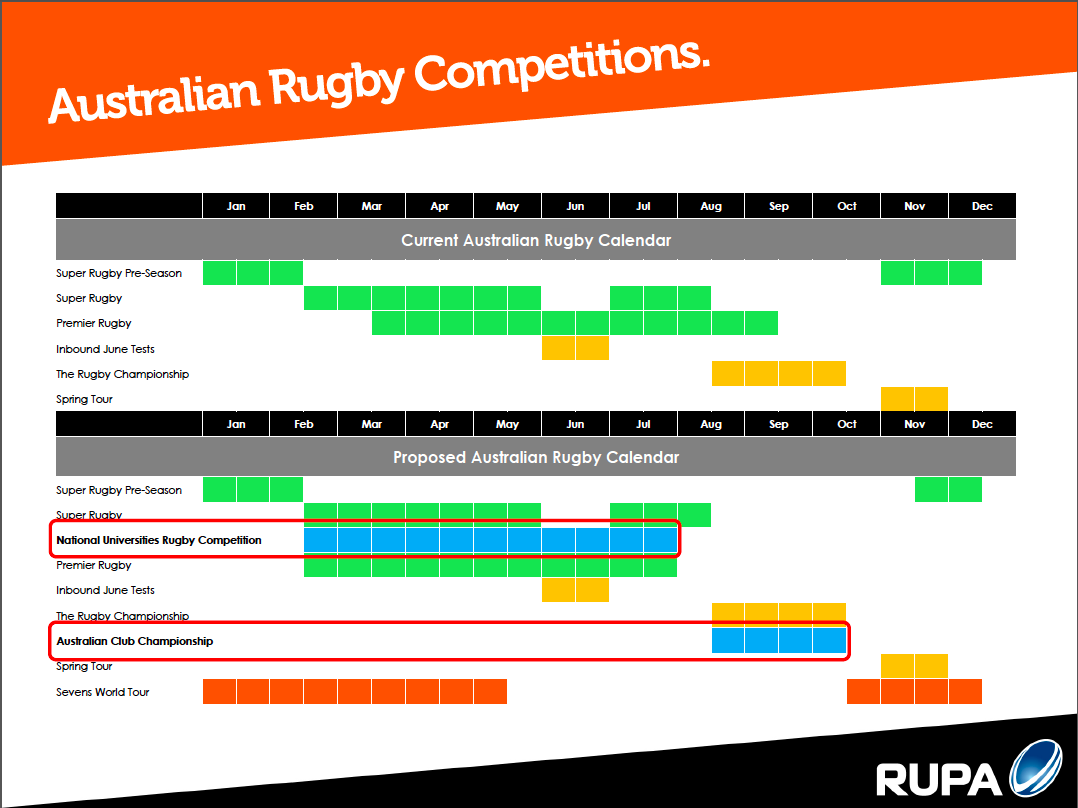
Click to explode

Click to explode

Make no bones about it, club rugby is likely to provide the spikiest sticking point for the proposal. If you do the rough maths, the Uni Comp would probably take around four top under-23 players from each premier club side during the regular season. While that would make an impact, it certainly isn’t insurmountable or club-wrecking.

The proposal also gives all clubs a new platform on which to compete in a national competition (unlike a Heineken Cup like model). For this national competition all of the Uni Comp players will be back in club colours, together with all Super Rugby players not then away on the Wallabies’ end-of-year tour.

Certainly, the Uni Comp teams would be a whole set of new forces, which many clubs currently struggling to hold their place in the world will resent. But with any major change like this comes major opportunity, and there are already premier clubs looking to see what benefits could be gained by partnering with a university.


The biggest uni clubs will just get bigger
The Death Star

The Death Star

This idea is probably a natural suspicion, but it could well be opposite to the truth.

Take another hypothetical: in 2013 you’re a talented young player who’s grown up with the Gordon club and you’d like a shot at Super Rugby. As things are, is Gordon the place you should stay right now, or does an über-club like Sydney Uni make more sense? Of course it’s Uni, because that’s where the facilities, coaches and selectors’ eyes are going to be focused.

In the new paradigm, you could gain access to the wider Tahs academy through (say) a Macquarie University team, and not have to leave the Gordon club — where you’d also have the prospect of  playing in the Australian Club Championship. You also get to pick up a degree or further education along the way.

The stranglehold and advantages that big uni clubs like Sydney have could actually be diluted.


Do you feel a draft?

Finally, there’s another point that I am surprised hasn’t got more airtime: the proprosed draft of players out of the under-23 comp and into full Super Rugby contracts. At the moment the NSW and Queensland powerhouses have an incumbent stanglehold on young talent coming through, largely due to history and geography. It’s resulted in the regrettable warehousing of young talent, whereby players are persuaded to wait as third or fourth back-up rather than get front-line exposure at a less established franchise. This definintely holds back the development of good young Aussie talent.

In the proposed system each Super franchise would get just the first three picks from their own academies, thereby levelling out the geographical playing field to a far greater degree than right now.

Is this the most easily workable third tier solution out there? I doubt it, and it’s already ruffling a feathers as you would expect.

But what I like about it is that it doesn’t say there is one simple solution to create a competition to rival the Currie Cup, because that is just not our reality in Australia. It also looks to draw in new resources and talent into the rugby eco-system.

Or as Greg says: ‘Mate, it grows the fuggen pie.’


Discussion »

  • NTA

    Good example, using Macquarie Uni. But will they still have the numbers to play Subbies?

    • http://www.greenandgoldrugby.com/ Matt Rowley

      Will who – the clubs?

      The uni comp will only take 225 players from the whole of Australia. Subbies will be largely untouched

      • NTA

        Having thought about it a bit further, most of the talent would effectively be joining the Uni for the rugby and degree, so wouldn’t affect their Subbies team. But I’m not convinced it helps grow the grassroots either… they’re hardly going to grow the grassroots that way either – . Notre Dame struggle to field two teams in Subbies so their participation would be questionable.

        I think that the country-based Universities should be encouraged though (e.g. UNE) because we don’t have enough arse-kicking country boys in our top rugby system.

        • http://www.greenandgoldrugby.com/ Andrew Mosey

          Just to clarify, it wasn’t all the Uni’s in the graphic, but rather in the case of NSW (and Notre Dame) ‘Three From’

  • Robson

    Sliightly oblique of topic I know, but depending on what is meant by “market”, NZ does have a market for a third tier comp. But I agree it isn’t a revenue gathering market; especially in the smaller centres, but it is a player harvesting and channelling market, if I can use that term in this context. I also think it’s what is badly needed in Australian rugby; but that of course is self evident by the appearance of this proposal.

    • http://www.greenandgoldrugby.com/ Matt Rowley

      Yeah, I was talking a commercial market to fund it

  • ooaahh

    Sounds like the American University system feeding the NFL

    My first reaction during reading the article was; doesn’t our elite players coming through university propel the myth that rugby is only for the elite? BUT i see the good side of this. The positive that a young guy who may only have had athletic talent and no exposure to work the brain muscle, actually being given a leg up in the world. Win win.

    My second more pragmatic reaction was for the young guy going through uni – what if he can’t do the course he’d like to at the uni he plays for.

    My final thoughts on this are it’s good. It clearly works in the states for NFL, it can work here for rugby. Matt can you clarify are the young guys going to be put on Uni scholarships as payment for playing?

    • http://www.greenandgoldrugby.com/ Matt Rowley

      In reply to your question, here’s the most relevant part of the proposal:

      “All players must be either enrolled in a higher education (Uni/TAFE) course or in approved work experience/employment in order to be eligible to play. This model is very similar to that which presently operates in the NYC and broadens the focus of the competition beyond rugby to facilitate personal development through strong support of education”

      So basically yes

  • Johnny-boy

    It strikes me as elitist, if not in action then it will certainly be the perception. That can be good and bad. Good in that we won’t get so many should-a-been mungoes and bad that we might miss out on some good, slightly blemished apples. I’m not sure in our competitive market that we can afford to shun those potentially good apples.
    Despite the fact that club rugby doesnt appear to have severly disadvantaged the Wallaby playing stock over the years (the biggest problem imo has been the last 3 idiot coaches) if you want a system that prepares players for Super Rugby, then a Super Rugby acadamy comp (even 2 teams per franchside) seems the most logical, leaving club rugby where it is. The Super teams already have the professionalism and facilites to get guys closer to Super quality than club rugby. There should be plenty of room and opportunity for those outside the acadamies to be slotted in if they are shining in club rugby. Injuries alone will ensure that.

    • http://www.greenandgoldrugby.com/ Matt Rowley

      1 – I don’t see what’s elitest about giving players – especially mungos – a chance at an education while playing. It’s actually quite the opposite

      2 – Your second paragraph about a Super Rugby academy comp is exactly what this is. Just that it’s based in Uni’s so that you don’t have to build the infrastructure.

  • The other Dave

    The university model here is controversial, but it has merit.

    Maybe we should also be focusing on the handful universities that are large enough and have existing sporting facilities (QUT, Mac, UNSW, Curtin, UWA, UWS, Monash, ANU, Melbourne, James Cook, Newcastle) and invest in them, rather than the smaller universities. Also, could they even align the unis to TAFEs in their districts? Uni’s not for everyone, and the trades are just as important as the professions. I also don’t believe in giving sportspeople a leg up for the purposes of admission to a course – Unis and TAFEs should be doing more to giving opportunity to people from disadvantaged backgrounds, regardless of their sporting ability.

  • Justtacklehim

    This is all based on the above article.

    The Uni component of this system is tough to understand. Are they creating a feeder system into and out off the existing system? Fast forward 2-3 years and if this happens, the clubs will align with uni’s, e.g. Griffith will have Sunnybank, souths and logan, QUT wil have brothers and norths, etc. most of these uni’s do not have a strucutured program of note so they are creating another system. And isn’t this what colts are for??? To me, stick to the existing system and build from it.

    And I just struggle with the commerical aspect of a 3rd tier competition. This isn’t the purpose of the system in Australia. It is a loss leader for the ARU. Create the talent that feeds the top tier products that sell. By itself, of course it loses, but like the NZRU, the ARU shouldn’t think of it like that. It’s like buying a mobile phone, the phone is generally a money losing proposition for the carrier or retailer, the money comes from other aspects, e.g. The plan or accessories.

    But again, I could be making something simple that is complex.

  • Johnno

    In the USA it;s not elitist, the college sports system. It’s been part of the culture for years. 300 million plus people, college basketball and football make big money, so costs are covered.

    In Australia it could become the following problems this model

    -Elitist
    -Player Welfare Issues (23yr old props packing down with 18 or 19yr old props, who are far less advanced in the scrummaging skills)
    -23-26 yr old players who still haven’t quite made it, will be tossed aside
    -The IRB model is senior rugby, and under-20 rugby. eg Under-20 world cup

    The model is a dud and outdated. Rugby is based on senior, and under-20, in the development model.

    -ARC is what’s needed.
    -Shute shield,Hospitals cup,John Dent cup, all too small to appeal to a broader and wider audience.

    -Australia has 22 million people. Does an Eastwood VS Randwick game really appeal to a broader audience in Australia, wanting to be introduced to rugby for the 1st time. A big no

    -But a South Brisbane Franchise VS West Sydney would

  • JimmyC

    Matt the thing I love about RUPA and the ARU is that they are looking outside the box. So many people just say bring back the ARC but the reason it was shit canned was because it leaked cash. Australian rugby can’t afford that even after the lions tour. I don’t want to see poor clubs like Penrith die because all the players want to go to uni for a chance to play in a national club competition. Can I suggest bringing back the state ‘a’ team programs run concurrently with super rugby. So when an aus plays another so do the ‘a’ teams. This would allow blokes to play at a higher level and not root the club system

    • http://www.greenandgoldrugby.com/ Matt Rowley

      Jimmy – if 3 or 4 under 23′s left the club do you really think Penrith would die?

      Those players would get to train in the Tahs academy and then come back and play for Penrith in the Australian National Competition.

      I can’t see the disaster

  • Nutta

    It’s a sensible model. I really like the uni/U23 model as it keeps a valuable part of our game (education leading to post-playing career) alongside with a fair-dinkum alternative to attract inside or outside talent other then by being on the back-page of the Tele for being a pissed idiot on a Mungo EOY tour or music festival.

    It’s a proper pathway to promote talent.

    The problem is unlocking uni old-boy funding. Imagine what Macq Uni would do with the corporate dollars that MGSM could unlock? UNSW would get the same through AGSM too. And don’t forget Melb Business School. What’s needed is for Labor to hurry up & lose the next election and get a mob back in-power who appreciate investment, incentive/reward it appropriately (that means lay-off on tax) and won’t try and kill the scheme for some quick “working families” commie/greens media-grab.

    And in terms of Shute Shield being the 3rd tier, go back and watch the semis & finals of the Currie Cup, ITM and Shit Shield and then rethink that statement…

  • Jets

    Firstly I’d like to say that I’m not against the idea. We need something in place and I’d be happy with anything that will improve the depth of rugby and access to more competitions for players to develop their skills and for fans to view. This is a situation where we need to get behind an idea that will work for the good of Australian rugby.
    In saying that I have to disagree with the comment that this would have little effect on Premier rugby as it would only take around 4 players from each club. In Brisbane the Premier comp is almost an U23 comp as it is with a few older heads thrown in the mix. Quite a few clubs would loose a substantial number of their talent to these Uni teams. Also they wouldn’t just loose them to the Qld Uni teams but I’m sure a lot would go to Canberra, Melbourne and Perth. Qld rugby has a great development system producing plenty of young talent. Some clubs would be stripped of most of their top line talent and thats going to have far reaching effect on a number of levels.
    I can see this as a good pathway and I like the education of players as a necessity to participate. Just don’t tell me that it won’t impact on Premier Rugby.

  • sheekabout

    Hi Matt,

    It’s my view that a national domestic comp is required for two reasons:

    1. To provide the Wallabies with a ready made pool of rugby hardened players whose skills and thought processes have been honed through intense, regular competition.

    2. To provide fans with their OWN national comp to follow; for youth to aspire towards playing in; a professional pathway; and revenue streams for sponsorship and viewership.

    It’s imperative Australian rugby has a comp to put up against AFL & NRL. Super Rugby (SR) by itself is NOT the answer.

    I don’t refer to it as third tier in my world, because the same teams would be competing in both SR and an Australian Rugby Championship (ARC).

    Therefore, in my view, technically, this is second tier – the last launching pad before Wallabies selection.

    SR would become like a Heineken Cup-style format, with the top four from the national comps of NZ, SA & Australia qualifying.

    Alternately, the Poidevin-Roche Heineken Cup-style model is designed more to protect premier rugby than it is to provide a viable bridge between the current massive gulf between club rugby and SR/tests.

    While I appreciate their sentiment, premier club rugby (Sydney Shute Shield & Brisbane Hospitals Cup) is not the answer. Talent is spread too thin with too many easy games. Historically, little has changed in a hundred years.

    The whole point of the exercise is to tighten the competition below the Wallabies. Premier rugby fails to achieve this.

    The RUPA Universities U/23 model is not the answer either. While it might be tempting to envisage a situation whereby one day Australian rugby might have a U.S.-style college comp system, that is a long, long way off.

    Let’s not fall into the trap of thinking that “something is better than nothing.” Let’s get the modeling right first go, then embed it.

    The ARC of 2007 was the right concept, but most regrettably, poorly implemented. Here are a few of the ‘clangers’ that saw the 2007 ARC become unworkable & unsustainable.

    a) Best 30 world cup players quarantined from competing. Any viable comp must have best players available.

    b) (East) Sydney Fleet playing out of North Sydney Oval. Idiotic decision.

    c) Sydney North Harbour players appearing for Central Coast Rays. Another idiotic decision.

    d) Huge cost of accommodating entire Melbourne Rebels squad in Victoria. Such an impost won’t be necessary next time.

    e) Playing on weekends & at reasonable sized venues. Should consider midweek (so as not to compete with AFL & NRL) & also consider smaller cost-effective venues initially.

    f) Those criticising so called “artificial” ARC clubs are clutching at straws. According to the George Lucas Star Wars mythology – “Every generation has a legend; every journey has a first step, every saga has a beginning.”

    When Sydney University rugby club first breathed life back in 1865, did people say it was artificial? The Melbourne Rebels & Western Sydney Wanderers are wonderful examples of well-thought out start-up clubs in recent times. There are many other recent examples as well.

    So you see, with better planning, the ARC will work. But premier rugby clubs need to let go the idea that they are more relevant than is the case.

    A suggested eight team ARC might be (say goodbye to provincial teams):

    Brisbane Reds (north & west of Brisbane river)

    Canberra Brumbies (all ACT/SNSW)

    East Sydney Fleet (south-east)

    Melbourne Rebels (all Victoria)

    Perth Force (all WA)

    South Brisbane Cane Cutters (south & east of Brisbane river)

    Sydney Waratahs (north harbour/shore)

    West Sydney Rams (greater west)

    Forget premier rugby clubs acting as feeder clubs to specific ARC clubs. No, the ARC clubs represent geographical areas.

    Premier rugby district clubs would be protected as follows: when you come out of high school, you MUST pass through a premier rugby club.

    You can’t be assigned to an academy, or ARC club or be selected for the Wallabies, without first progressing through a premier rugby district club.

    I trust this helps.

Close