
Wallabies – It’s Time For A Fightback! Part 2

Scott Allen August 30, 2012 49

No Gravatar

In Part 1 of my Wallabies Fightback series I looked at the Wallabies’ first phase backline plays. I believe that a central part of the Wallabies’ game plan should be attacking more with our backline on first phase from set pieces.

It’s important that any component of a game plan links to other parts of the game plan so before the Wallabies can attack more from first phase on set pieces we need to be sure we can not only win our set pieces but win clean ball that establishes a solid platform.

In part 1 I showed the first phase set piece opportunities the Wallabies had within 60 metres of the try line in the first two TRC matches. Of the 27 opportunities I identified, seven of those came from scrums and twenty from lineouts – roughly a 1 to 3 ratio. In international rugby around 20 per cent of all tries are scored from a possession starting from a scrum whilst 30 per cent are started from a lineout – roughly a 2 to 3 ratio.

Today I’m going to look at the Wallabies’ scrum and in Part 3 of this series I’ll look at the lineout. When I started writing this piece I expected it would be relatively short but in trying to do justice to the topic it turned out to be quite the opposite. I hope you can find the time to get through the whole article and the accompanying video.

We all know that the Wallabies’ scrum has not been strong during most of the professional era. We’ve had brief periods in which the Wallabies were competitive, and even a few where the Wallabies had a dominant scrum. The last of those was in 2009 on the Wallabies end-of-year tour when Benn Robinson, Stephen Moore and Ben Alexander were the starting front row with Tatafu Polota-Nau coming off the bench.  Click here to see some video highlights I put together of the front row’s performance against Wales in 2009.

In 2012 the Wallabies have obviously decided to build their scrum on keeping together the Waratahs front row combination that performed quite well in the Super Rugby competition, so we’ve seen a starting front row of Benn Robinson, Tatafu Polota-Nau and Sekope Kepu.

In the series against Wales the Wallabies’ scrum was really poor. Benn Robinson in particular looked out of form and the Welsh dominated at scrum time. Click here to see my video analysis of the Wallabies’ scrum against Wales in the third Test.

In the two TRC matches so far against the All Blacks the Wallabies coaches have had to change the front row around to accommodate injuries.  In TRC 3 Stephen Moore replaced Polota-Nau and Ben Alexander replaced Kepu. Interestingly, this brought the 2009 starting front row back together – Robinson, Moore and Alexander.

So how has the Wallabies scrum performed in those first two matches? I have to say it has continued to be poor.

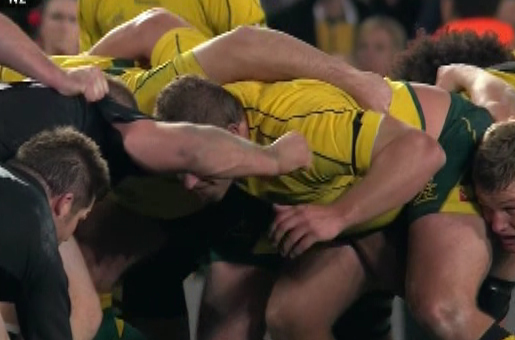
Rather than look at statistics for scrums won compared to scrums lost or even which team the referee penalised, I’ve looked at scrum performance by analysing in detail each of the 35 scrums packed in the two matches.

In my opinion the Wallabies scrummaged well in only 42 per cent of those scrums. They were dominant in only 20 per cent of scrums and achieved parity in another 22 per cent. The All Blacks were dominant in 58 per cent of scrums. Add in that 22 per cent of scrums where there was parity and the All Blacks scrummaged well in 80 per cent of scrums, almost double the Wallabies’ rate.

In TRC 1 the Wallabies were dominant in two of 18 scrums (11 per cent) and achieved parity in another five (28 per cent) for a good performance rate of 39 per cent.

In TRC 3 the Wallabies were dominant in five of 17 scrums (29 per cent) and achieving parity in another four (24 per cent) for a good performance rate of 53 per cent. So there was improvement from the first match to the second, but performing well in 53 per cent of scrums is not good enough.

What contributed to that improvement? The first factor is the All Blacks’ front row – they had a significantly weaker scrum with Wyatt Crocket starting for the injured Tony Woodcock (whom I regard as the best loosehead in world rugby – he’s not a myth in my opinion). When Ben Franks came on for Crockett that situation changed, as Franks is a really good scrummager.

In determining other factors I looked at which side of our scrum performed best in each match.

In the first match when the Wallabies scrummaged poorly it was the tighthead side under most pressure – in five of the 11 scrums (46 per cent) the tighthead side was in trouble and in another three both sides were in trouble (27 per cent), so 73 per cent of poor scrums involved problems on the tighthead side.

In the second match when the Wallabies scrummaged poorly it was again the tighthead side under most pressure – in five of the nine scrums (56 per cent) the tighthead side was in trouble and in another four both sides were in trouble (44 per cent), so in every scrum where the Wallabies scrummaged poorly the tighthead side was in trouble.

Overall 17 of the Wallabies’ 20 poor scrums in the two matches (85 per cent) involved problems for the tighthead side while only seven of the 20 (35 per cent) involved problems on the loosehead side.

In each match the Wallabies conceded one tighthead and on both occasions it was the tighthead side that was the problem.

In the second match New Zealand conceded a tighthead when Andrew Hore was penalised for standing up.  Unfortunately for the Wallabies this was only achieved by Ben Alexander boring in on Hore and whilst he may have got away with it on that occasion, a more observant referee would have penalised Alexander — so the fact that a turnover was achieved shouldn’t give the false impression that it offers something to build on for the future.

Another factor was an improvement in scrummaging by Benn Robinson. I still think he’s the best loosehead the Wallabies have but I believe he needs to work much harder on his fitness to regain his place as one of the best looseheads in the world.

I’ve made no secret of my views that Stephen Moore is a better hooker than Tatafu Polota-Nau by some margin based on all aspects of the game, and the differences in their scrummaging performance in the two matches again confirmed that for me.

In analysing the performances of Polota-Nau and Moore it would be easy to say that it is no coincidence that the improvement in the Wallabies’ scrum from the first match to the second came with Moore starting in the second match. I’ve looked further than just the headline numbers to see whether either hooker made a difference, either through a dominant performance or through poor scrummaging.

With the All Blacks feeding the scrum the Wallabies hooker isn’t striking for the ball – there’s no point as the ball is not fed anywhere the tunnel these days so the hooker effectively becomes a third prop. In the first match with the All Blacks feeding Polota-Nau went down on his knees in three of 11 scrums (27 per cent) and stood up on another – that’s 36 per cent of defensive scrums where Polota-Nau was a passenger in the scrum. In one scrum with the Wallabies feeding Polota-Nau was isolated and driven out of the scrum. That’s five of the 18 scrums he packed to in the match (28 per cent) where Polota-Nau scrummaged poorly.

In both matches Moore packed into 23 scrums and stood up in one scrum. That’s  four per cent of scrums where he scrummaged poorly.

Observing the scrums from a distance it’s not possible to tell which scrums the hooker may have been dominant in.

Whilst I’m sure that some people will claim I’ve come up with an analysis to support my own views, I don’t see hooker as the problem area in our scrum, and Polota-Nau is a good player who should be part of the Wallabies 22 whenever he’s available.

I believe there are three problem areas for the Wallabies scrum that should be a priority for attention. The first is the fitness of the front row; the second is a lack of depth of front-rowers; and the third is at tighthead.

The fitness of the front rowers is not an issue for them alone – it’s clear that most of the Wallaby forwards are walking too often and whilst some of that may relate to a lack of mental application, it appears from watching them that there needs to be an increased emphasis on conditioning. This is of course not just an issue for the Wallabies – much of the conditioning work needs to be done whilst the players are with their Super Rugby teams. There obviously needs to be better cooperation between the Wallabies management and those of the Super Rugby teams for players who are in the Wallabies mix, so that players arrive at Wallabies sessions fit enough to play the team’s game plan.

The depth of quality front rowers in Australia is a concern. Whilst there are a number of promising prospects coming through the system it’s my view that many of them have been selected primarily based on body size and shape rather than for their technical ability. It’s great to have big, strong players in the front row but a smaller player with good technique can be even more effective. Benn Robinson is a perfect example – you’d hardly identify him for his physical size and shape yet when he’s in form his technique allows him to dominate most tightheads.

Patricio Noriega was a good scrummager but much of his scrum coaching at the Wallabies revolved around the physical requirements of the scrum. I believe the Wallabies’ last period with a good scrum at international level was a result of Michael Foley’s time as assistant coach. Foley is a very technical coach and the work he did on the technique of the Wallabies’ scrum in 2008 paid dividends in 2009. It was no surprise to me that with Foley as the forwards coach at the Waratahs, their scrum looked very good technically. If we are to establish depth in Australia’s front row stocks there needs to be a technical emphasis, and that needs to be driven by the ARU on a national basis.

The third issue I see for the Wallabies is at tighthead – the tighthead is the rock you build your scrum on. Due to the offset of the front rows a scrum naturally wheels clockwise even if all players push completely straight. This natural wheel works against the tighthead who effectively has to deal with the force coming from both the opposition loosehead and hooker. The first goal of the tighthead after the engage is therefore defensive — to hold that force and not be moved backwards. To do this he has to get a low body height and be rigid to be in the best position to resist.  The first goal of the loosehead after the engage is attacking — to disrupt the tighthead so he cannot resist the force. To do this he aims to get under the tighthead and lift him enough that he is not in a good low position to resist the force.  Once this occurs the tighthead goes backwards and the natural wheel takes over, which destroys the scrum.

As my numbers for the first two 2012 TRC matches show the Wallabies scrum is struggling on the tighthead side, even more so in TRC 3.

In TRC 1 and for most of the series Sekope Kepu played tighthead for the Wallabies. In the past he’s been used on both sides of the scrum by the Wallabies and as I’ve shown in a previous video analysis he struggles when playing loosehead.

In TRC 3 Ben Alexander started as tighthead and in fact played the whole game there. Whilst his form in 2009 at tighthead was good I haven’t seen that form since.

The problems for both players are, not surprisingly, technical. They are both setting up too high and not driving their hips down and through when they engage. As a result they are both caught high quite often which gives the opposition loosehead to much room to get in underneath them resulting in the tighthead not being able to resist the force coming from the opposition loosehead.

In previous articles I’ve made the point that a good scrum relies on the whole pack working together. In particular the lock and flanker on each side must work with the prop they are binding on. Both the lock and the flanker must stay bound on the prop and provide as much force as they can – otherwise the prop has no force to transfer through to the opposition.

Given the importance of the tighthead side to a stable scrum, the force provided from the tighthead-side lock is critical.  This means that tighthead lock is a specialist position – you need your strongest lock on that side of the scrum – it’s not a case of players having a preference as to which side they pack on. You need to select a specialist tighthead lock who trains for that role, whereas on the loosehead side you have some flexibility in the player you select probably with more of an emphasis on lineout capabilities.

The Wallabies have a number of tighthead locks in and around the system – James Horwill is clearly the best of these, not just in terms of his scrummaging but for his lineout work and general play. With his absence through injury Nathan Sharpe and Sitaleki Timani have filled the role in 2012. Rob Simmons is not a tighthead lock so whilst the choice between Timani and Simmons generates plenty of discussion, Simmons will only make the starting team if a specialist tighthead lock is available. I’ve seen no difference between Sharpe and Timani as tighthead locks in 2012 when it comes to scrummaging. Whilst much has been made of the tighthead that the Wallabies conceded in TRC 1 when Timani was off the field and Simmons was on, it was actually Sharpe who packed at tighthead lock in that scrum, and whilst it was the tighthead side of the scrum that was the problem as you’ll see in the accompanying video, it was Kepu that was the problem, not the lack of force coming from behind him. I haven’t seen any evidence of problems with our tighthead locks’ work in the scrums in 2012. The issues on the tighthead side have all been as a result of the tighthead prop.

In the accompanying video I’ve shown how the body height and body shape of both Kepu and Alexander has been poor. These issues can be addressed through better flexibility and conditioning to allow the prop to start with his hips in a lower position. Conditioning work can also improve the players’ core strength which is crucial in resisting the force coming through from the opposition prop.

However, the biggest issue is technical – no matter how much force comes through from behind him the prop cannot transfer that force to the opposition if he cannot maintain a flat back. With an arched back the force does not go through to the opposition, it goes downwards and is wasted. Both Kepu and Alexander have the same technical problem in this regard. It can be fixed (and in a relatively short period of time) but it takes plenty of hard work and commitment to maintain a good body shape in every scrum.

In my opinion Alexander can improve his technique but he is not really a tighthead and should not be selected in that position for the Wallabies. Similarly, Kepu is not a loosehead and shouldn’t be selected in that position for the Wallabies. James Slipper is someone who can play both sides but I think he should be considered a tighthead who can play loosehead – he is probably the best bench option the Wallabies have in the system. Of course in 2013 the Wallabies will have to select a full front row on the bench under the coming experimental laws so this will change the dynamics again.

Given the importance of the tighthead side of the scrum I believe you have to select the best technical prop you can on that side of the scrum – for me that’s Dan Palmer, and I hope once he’s back from injury he’s given the role.

Get it right on the tighthead side of the scrum and you can build a platform to attack from – then if you can’t score a pushover try, release the backs with first phase plays from the scrum.

Discussion »

  • DC.

    If people would like to comment under this post on what their preferred back-line would be if no injuries had occurred this super rugby season (I know, it will never happen) it would be much appreciated, I am very interested in people’s opinions.

    Would Lealilifano grabbed the 10 jersey? Tapuai in the 12? O’Connor on the wing? Maybe a surprise entry by Andrew Smith in the 13? (I know he is never part of the discussion, but he did have the best super rugby stats out of any Australian 13 by a country mile).

    Genia. Cooper / Leal. Digby / Taps / AAC / O’Connor / Beale.

  • Swat

    DC. Use the Forums for that kind of discussion.

  • Jimmy

    That’s a tough one at present.

    09 – Genia
    10 – O’Conner
    11 – Ione
    12 – Undecided / Can’t think of a really good one. Possibly Barnes before his head knock. Maybe Taps
    13 – AAC
    14 – Mitchell
    15 – Beale

  • NTA

    Woodcock – when reffed properly – is probably only the equal of the top three of four Kiwi looseheads at scrum time. When he’s allowed to step around and bore in, as most refs seem content to do, he’s much more of a handful. The fact that he’s that good in tight and a berserker in the loose is probably more impressive overall.

    There are very few tighthead props at any level who can handle a loosehead at the same level boring in on them (I was primarily a loosehead and loved refs who knew nothing about scrums, which is 90% of them) no matter the difference in weight. It is why the number 3 is the most important in the game, bar none.

    Our scrum has been vilified, and rightly so, for dropping when things aren’t ideal, but testing the ref’s patience may cost far less then turning over the ball so in terms of harm minimisation it is a sound scheme.

    If our props can bend their levers a bit more, and the hips and shoulders are aligned, and the locks and props eat, sleep, and breathe together as brothers, at this level there is no excuse for getting pushed off the ball. Get the ball in, strike it quick, and then lock the front row down, hips low, and let them waste their energy.

    • chasmac

      Artist formerly known as nutter;

      Are you a Dan Palmer fan?

  • @sackdeansnow

    Nick White – Larkham – Joe Roth – Nathan Grey – Mortlock – Digby – Matt burke

  • Mart

    Again it has become a Deans trait to create utility players and play people out of position.

    It baffles me why you would ever play props out of position.

    Apart from the halves it seems to me to be the most specialised position on the paddock.

    Pick the players in the right positions and there’s no excuses.

    AAC to 13

    • DC.

      How big of a deal is it to switch a no1. prop to no.3 and visa versa? Is it as big of an issue like trying to put use a 6 at 7? (Mccalman against Ireland) or is it more like just switching 11 and 14?

      I don’t know much about scrums, but i am guess one’s aim is to push the scrum up and the opposite to push it down?

      • Scott Allen

        It’s a big deal to switch sides – very different roles.

        A player may be capable of playing both sides but once you get into the rhythm of leading the scrum in from TH if you then switch over to LH and lead in like you were at the last scrum, your scrum will be poor.

        Similarly if you’re playing at LH and being led in by the TH, if you then move to TH for the next scrum and don’t lead in, your scrum will be very poor.

        Many other technical differences but I think fair to say there are very few props who can play both sides at a high level. If they can, they’re pretty valuable.

      • Robson

        Also different position for feet.

    • Hooper for 12

      My laymans understanding of the logic here is that Deans, who coaches by statistics, would trade a great THP who is slow around the field, for a more mobile THP who can truck it up, participate at the breakdown, and not get easily stepped by nifty 9s in defence. As most of the game is attack, defence and breakdown, not set piece / scrums, the logic to me is sound. The problem is that we cannot find a THP who is mobile but also not a liability in the scrums.

      How a professional THP like Kepu can have poor technique is beyond me.

  • JJJ

    You’d think with Kepu having Foley as a coach for the whole super season his technique would be in great shape. I guess Foley had other things on his mind.

    I wonder if our props have been told to engage a bit higher because refs are cracking down on collapses? I remember in that podcast interview Al Baxter said that the problem with AB vs Wallabies matches was that they both liked to scrum low and get in under the opposition. Since they were both trying to do that the result was a collapse more often than not, with the ABs getting the benefit of the doubt. Maybe the wobs have decided to focus more on not collapsing than on winning the scrum? Or maybe our tightheads just aren’t very good…

    It’s a damned shame JON didn’t spend the money he’s thrown at Deans on luring Mike Cron over the ditch. There’d be plenty for him to do here.

    • bludge

      al baxter! good one. hilarious

      • JJJ

        If you can point me in the direction of another extensive interview with a modern prop, where he talks about the nitty gritty of scrummaging and the characteristics of various international scrums I’d be grateful.

        For whatever reason this category of interview is extremely hard to find. I’ve only ever seen the one.

        More front-row interviews, GAGR!

  • Red Beard

    Fantastic article mate. I could read theories about scrummaging until the cows come home. As a neutral (I’m a Kiwi) I’ve liked what I’ve seen of Dan Palmer for quite sometime. He has what I call the “born to scrum look” which every good tighthead is blessed with. You either are a tighthead or your arent. I dont believe they can be fabricated. It comes down to whether or not you not only are happy to be constantly placed under intense physical and mental pressure…. but crucially whether you have the will to front up at every set piece. Technically Owen Franks gets caught out from time to time… but his desire to dominate can never be questioned. What are your thoughts on Paddy Ryan? I must admit I have watched very little of the Tahs this season but I do remember watching him once this year (can’t remember who against though) and thought he aquitted himself quite well.
    Crockett is a real liability at scrum time IMO. I know the guy might have played 100 Super games but I dont know why the AB selectors persist with him. I am a Chiefs supporter and have found the progress of young Ben Tamiefuna phenomenal this season. The 140kgs behemoth has benefited enormously under the tutelage of Carl Hoeft. With Sona Taumalolo off to France I wouldnt be at all surprised to see Tamiefuna get some gametime at loosehead for the Chiefs next year as well. Hawkes Bay have used him there already. That would give the Chiefs an enormous starting front row of Tamiefuna, Schwalger and Afeaki which could well propel both Chiefs props into AB squad contention. Despite possessing the biggest pair of legs in world rugby when fully fit Tamiefuna is extremely light on his feet and can be dynamic with ball in hand (core duties first obviously). He was actually a star touch player at secondary school. Tamiefuna, Afekai and Charlie Faumuina are going to put real pressure on Crockett and Ben Franks when the two prop rule comes in at test level later this season. I actually think NZ is flush with tightheads at the moment, finding the long term replacement for Woodcock however is going to be fascinating. Before I forget in another two seasons I think young Canes TH Jeff Toomaga-Allen is also going to come into the mix.

    • Mighty Moth

      I agree with your comments about Tamiefuna. For such a big unit he was everywhere in S15, and scored a few tries too. Absolute pleasure to watch that guy play. Him being a former touch player explains a lot now. I was bewildered how such a huge guy could get around so well. Smart positional play and reading the game would also help cut out some of the meandering around the field the Wallabies are doing. I feel sorry the forwards doing a whole lot of work for the ball to be handed back to the opposition with poor kicking.

  • Red Beard

    In that last scrum (at 3:00) while I totally agree that Ben Franks didnt have his bind up, you could also argue that Alexander binding on Franks outside arm makes it doubly difficult for Franks to adjust his position. Mind you I am a former TH and dont think in fifteen years of senior football I ever bound correctly on the opposing LH. I would drive down onto the back of their neck, bind on their arm and drive their chin into their sternum all day long if the ref let me get away with it! So fair play to Alexander.

    • Scott Allen

      I thought the same about Alexander’s bind at first. When you go through it frame by frame his initial bind is under the armpit which seems to be acceptable to refs these days. Then with Franks arm pointing down, Alexander’s hand slides down.

      But having said that one of Alexander’s technical issues at TH has always been binding on the arm – I’m surprised he’s not penalised more but I suppose refs have a fair bit to watch so close enough is probably good enough for them.

      • Red Beard

        I’m loving this front row discussion! I’ feel like like a pig in slop.

  • Duncher

    another cracking read… Surely the blokes in our top job are looking at these things in as much detail?

    • bludge

      they know what theyre talking about and are sure to have better footage to judge.

      or, on the other hand… congrats to some guy called scott for inventing video analysis! now for a patent

  • D.

    I disagree with your comment on your video that Frank’s hand on the ground has no consequence. It SHOULD have been penalized therefore giving the Wallabies either a shot at goal or to be able to apply pressure (I know that is a joke at the moment)

    Rules are rules. This could be a tactic that the Wallabies target Franks. It maybe boring, but I rather win the Bledisloe with boring rugby than with the crap that was served up last weekend.

    • Scott Allen

      No doubt it should be a penalty but if you penalise everything that’s not perfectly legal in a scrum I doubt you’ll ever have a completed scrum.

      My point was more did it have any impact on the All Blacks being dominant in that scrum. If a LH puts his hand on the ground and uses it to gain an advantage to lever himself up and therefore lift the TH then an advantage is gained. In that particular case Franks didn’t drive upwards by having his hand on the ground – he drove through at the same height so that didn’t create the dominant scrum.

      The purpose of my anlaysis was to work out which scrum was dominant and on what side unless that domination was achieved by illegal means, like the penalty Alexander earned against Hore.

      • D.

        Don’t get me wrong, I agree with your analysis, but having said that, my point is, at the initial contact, is the Australian scrum getting a better hit on the kiwis or is the kiwi scrum not set correctly which forces Franks to put his hand down. If he didn’t put his hand down, would the scrum collapse and Australia be awarded a penalty.

        By not being penalized for this infringement, is this giving the kiwis an unfair advantage? Yes their scrum is dominant, but it’s not truly dominant if he can’t take the initial hit without putting his hand on the ground

        Let’s be honest, it is much easier to call a hand on the ground than who’s to blame for a collapsed scrum.

  • Big Ted

    Hate to add in my two bob as a fullback, but…

    The argument about the amount of game time lost in the set piece, namely the scrums, I feel is a valid one. I was watching some footage of the ’99 World Cup not too long ago and was amazed to see forwards jogging to set a scrum, setting nice and close, the ref placing a warm hand on the shoulders of the opposing tight and loosehead props and then allowing the front rows to “lean” on each other before the real shove began. I couldn’t help but notice the amount of resets the scrums required were minimal when compared to rugby of today.

    I am not trying to trivialise the art of the scrum at all, as it is an area of the game i certainly never possessed the gumption to venture, but can someone please enlighten this naive fudge packing fairy on what the puck has changed in the laws/techniques so that so much time is lost in the average game these days on scrums?

    • Pedro

      There was an article on this a while back. Whilst not an expert myself, the general consensus was that now there is much more emphasis on the hit. Opposing players are also further apart and bigger units. The “touch pause engage” bollocks in its current form doesn’t help either.

  • Big Ted

    Bloody good article by the way Mr Allen, always a pleasure reading your stuff

  • murph

    Paddy Ryan just got the call up. Big surprise. The ARU-Tah circle jerk continues at pace.

  • Morsie

    Paddy Ryan destroyed Ben Alexander in the S15 match this year.

    • Bob

      Which makes you question why he wasn’t enlisted sooner

  • Johnny-boy

    Great article Scott and so thrilled to hear about nz props on the green and gold Australian rugby site red beard ….really fascinating and I’m sure it will help Australian rugby. …Is there some of sort of rugby discussion ban on nz sites ?
    Back to Australian rugby, Patricia Noreiga was obviously a waste of time training the wallabies scrum and perhaps topo r is the man. He couldn’t fo any worse.. Ben Robinson has struggled since his knee injury. The Wararahs medical staffs history of injury management has been very very poor over the yesrs. I’d like to know your opinion of Greg Holmes scrummaging cos when Link takes over soon I’d be very surprised if he didn’t get a Wallaby gig. Did you play NFL Scott ? I seem to remember a Scott guy as one of the original Aussies to play over there many years ago. It would explain your love of technical analysis which is very good.

    • Scott Allen

      JB – I think Holmes has been scrummaging very well for the Reds this year.

      No NFL for me but since learning the rules a few years ago I really enjoy watching the game.

  • Johnny-boy

    That confirms my suspicion that Deans and the Tahs are closer than what they are letting on. There’s a certain air of inevitability that Tom Carter will get a gig soon ….

    • Pie Thrower

      Seriously if Tom Carter ever wears Wallaby Gold (apart from in his own bedroom whilst looking at himself in the mirror whilst doing his hair) I will never ever support the Wallabies again and (and you have no idea how much this hurts) claim that Nu Zilland passport that I am entitled to and start supporting the darkness. It will be far less painful than supporting a team that has that fucking halfwit in it.

      • bludge

        ….thats like saying if the weather stays like this i swear i’ll sell this shitty 1982 toyota and start driving the ferrari i’ve had sitting in the garage all these years.

        what on earth have you been thinking

  • Queenslander

    It really is the sequencing that screws up scrummaging. Look at any scrum from 10 years ago and they were quick dirty and efficient. Holding back a couple of ton of man meat and expecting a good result is crazy. I understand the pause may be going from the refs calls and you have to question if the argument around safety really applies when we reset so often.

    it is a method of restart and a dark art I love watching but it is beginning to dominate in terms of minutes wasted

  • Deez

    Great article and very enlightening for those who are not front row forwards, but appreciate some physics.

    In the absence of Palmer and Kepu right now, do you think Alexander is the next best option? Or do we go with Slipper to start? Also saw elsewhere that Paddy Ryan got the call up for the squad – haven’t got a specific view on his scrummaging, but secondary comments suggest he’s a battler on the tight head side. Any thoughts?

    • Scott Allen

      I think Slipper is a better TH than Alexander.

      Haven’t watched much of Ryan scrummaging so can’t really give an opinion on him.

  • Trevor Nuff

    I’ve heard very negative reports on the performances of Topo and Noriega as coaches over the years from players who know. With the exception of Foley and perhaps Alec Evans (and Link) there is a serious lack of quality, experienced and successful front row coaches in Australia – at all levels.
    I would suggest if the Wallabies were serious they would look to bring on board a Phil Vickery/Trevor Woodman type character. I think from memory Woodman was involved with Syd Uni for a few years following his retirement.
    Lets be honest… we’ve got a Kiwi coach so we should embrace a foreign front row coach if a suitable person can’t be found here.

    The reality is however the ARU doesn’t have the funds to put in the place a structure that would hopefully delivery success. Deans only had himself and 2 or 3 others when he first started and then over the years we’ve added Nucifora and McGahan etc to the mix. The reality is NZ had a huge coaching team last year (aside from Hansen, Smith and Henry)… SA in 2007 has White and Eddie Jones and a host of others whilst Woodward in 2003 had coaches for everything from hand/eye co-ordination to goal kicking and so on.

    What have we got? A goal kicking coach on Skype from SA? A support team of 3-4 people for Deans that changes for whatever reason every 2 years.

    If we are fair dinkum and want to be the best… and the ARU wants that then you put together a ‘team’ off field to give the boys on field the best chance of achieving the goal. The reality is however JON doesn’t care if we are no 1 or 2… he just wants to run a tight ship… fill the bank accounts and protect a legacy with the ARU of solid financial management.

    And the truth is… with the NRL deal and AFL going great gun the ARU is going to be left behind. What we need is another rugby world championship coup… but one that is successful and sees the game injected with some serious money in this country and gets rugby on free to air tv, gets kids playing the game again and creates pathways to the Wallabies with quality coaching along the way.

  • boutbloodytime

    Brilliant & fascinating analysis Scott…

    If only high school physics was taught this way & applied those vector diagrams & stress/strain/load/buckling principles etc to something meaningful like rugby scrums, the breakdown etc, my exam results would have looked a lot prettier.

    From this analysis, my only real question is: When we have a scrum that is firing under Messrs Foley & Noriega in 2009, why do we then dissolve the coaching structure that made it so successful?

    And who is responsible for those decisions? (Deans or someone higher up the food chain?)

    • Pedro

      Yeah that was weird. Felt good to have a scary scrum, even if only for a short time.

  • Joe Blow

    The Americas Cup win was one of the great moments in Australian sports history.
    Up until that point each country involved presented a campaign that was 100% home grown, from designers and investors right through to tacticians, skippers and crew.
    Shortly after this win many non sailors lost interest in it as a sporting event because it became a bit of a free for all with national borders frequently crossed for whoever was the highest bidder.
    It would be a shame for rugby to also go this way in Australia. I can understand how a developing rugby nation could benefit greatly from having foreign coaching and administration people in place. However, we are hardly a developing rugby nation and we have many good coaches at home and abroad to choose from for our national team.
    It is time for a fightback. It is also time to reinstate a home grown coach and never make the mistake of going abroad again.
    As always a very informative and knowledgeable piece Scott. Thanks again!

  • TC63

    Scott another great analysis.
    Wil be interesting to see the impact Andrew Blades has as the recently appointed scrum coach.
    Personal experience is that he has a great technical understanding and has been very successful in passing that on to the teams he has coached with good results.
    Walllabies is a new level and interesting to see how he goes. My view is that he will make a very positive impact.

    cheers TC

  • Liam

    Scott,
    A couple of points regarding the analysis of Dagg’s try. Ashley-Cooper over commits to Gear ie he is still moving infield by the time the ball is in Dagg’s’ hands. Assuming his role in the defence system is to remain, if possible, on the outside attacker then he has made an error which will be difficult to correct. If the fullback is meant to fold around the outside frontline defender then Beale is also at fault as he is too deep. As you say he has two options-take the inside runner or the outside receiver. The cover would have found it easier to help if he had stayed out. Note also McCaw packs on the blindside for this play-he is effective at using his body to occupy space and holding the attention of Genia and the flanker.
    I rate your video analysis clips very highly and find them very useful for understanding the game.

  • Robbo

    Great analysis. I also agree with Liam that AAC was at fault here. As a winger he should always cover the outside man which was Dagg. Beale should have covered the inside man. Beale was (correctly) positioned to cover the inside man.

  • sarina

    The crouch touch set sequence trialed in nzs itm cup seems much beta and the 5sec rule use it at ruck n maul as wel. I cn c both rules being used

    • rae1

      Yes,it seems to have taken the game to the next level with regards to the speed in which all of the ITM games are being played.

  • Pingback: Wallabies – It’s Time For A Fightback! Part 3 - Green and Gold Rugby Blog

  • Pingback: Wallabies general play kicking analysis and video

Close